Skip to content

From humble beginnings, the Paynes have focused on increasing their herd’s potential – a passion that now spans generations.
Fast‑forward to 2003, the family relocated their operation to the heart of Cambridge, Waikato, purchasing the block that the farm operates on today. Over the past two decades, the transformation of the Payne’s herd has been nothing short of remarkable.
The family’s farm has continued to evolve under Rex’s son Brad Payne, who inherited both the herd and his father’s enthusiasm for breeding. Brad is committed to genetic improvement within his herd. Through careful selection, embryo transfer work and a deep understanding of cow families, he has elevated the herd to a new level. It’s a true testament to the work of him and his father: building better cows, season after season.
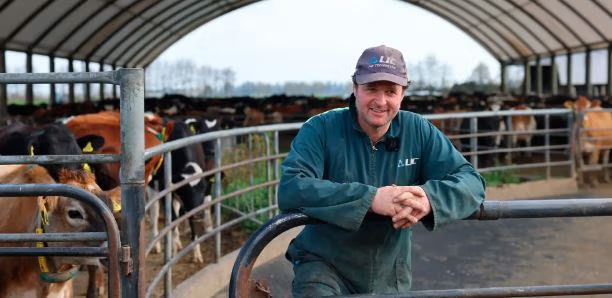
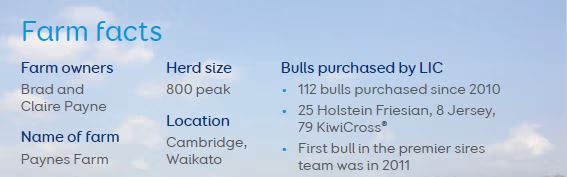
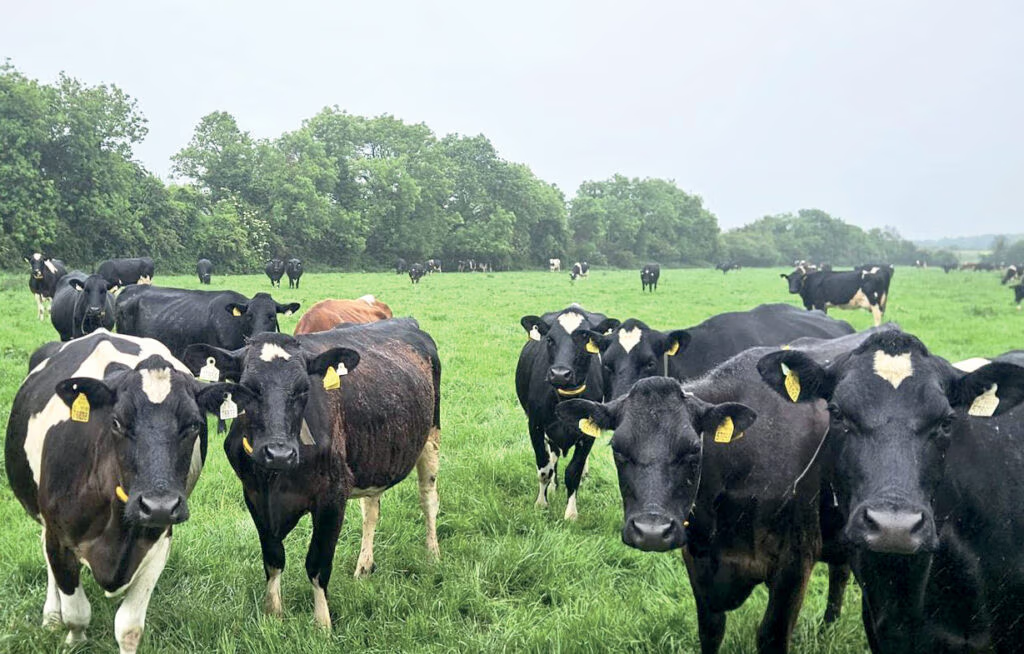
Today, the Payne farm runs close to 800 cows, expanding steadily each year. The farm operates mostly as a system 3, with supplementary feeding to ensure the cows perform to their genetic potential year‑round.
The farm is very much a family affair. Brad and his wife Claire manage the day‑to‑day, and father Rex steps in during peak times, particularly calving. They’re supported by one part‑time staff member, and together they manage their unique farm demands.
During calving, the Payne family rear more than 500 calves, a massive undertaking that reflects the commitment to their breeding operation.
Calving runs from May 1st through to the end of September, which is different to traditional spring calving, but their decision is tactical. They aim to calve around 150 cows per month, or roughly five cows a day.
Brad says the decision to calve 150 cows per month isn’t just about pacing, it’s about practicality.
“If we had a normal spring calving and had to rear 550 calves all at once it’d be a massive workload. The feeders just wouldn’t cope, and teaching calves to feed would be chaos.”
To manage this volume, the farm uses automated calf feeders, which have become an essential part of the system. Each unit can feed up to 150 calves, and with three units on site, including a new high‑capacity feeder that can handle 250 calves at a push.
“Teaching five calves a day is manageable. Teaching 40 in one go? That’s a whole different story. Everything we do here is tailored to what works for us.”
Brad’s real passion lies in his breeding programme. He invests heavily in embryo transfer (ET) work to give him more opportunities to breed more replacements from his top cows each season.
A bonus of the Payne farm’s early calving schedule is the opportunity to rear and observe daughters from LIC’s SPS bulls ahead of other SPS farmers. “It’s really neat to have that slight head start,” Brad says. “We get to see which of those bulls produce what daughters before most others do, helping bulls get there proofs as early as possible.”
Brad is also a trained AB technician, which means he not only inseminates all his own cows but also runs a local mini‑AB round. His passion for breeding spills over into every phase of the reproduction cycle, from getting cows in calf to rearing the resulting calves. “I draft the cows and immediately I can inseminate them, just another way to be as efficient as possible in our layered system.”
The ET programme is the heart of Brad’s strategy. Each year, he carefully selects the top 60 dams based on their genomics, production records, and overall health. Using ET, he implants embryos into surrogate cows to increase the number of calves born from his elite dams. This technique allows him to produce multiple offspring from his very best cows each year, accelerating genetic progress compared to traditional breeding.
The results speak for themselves. With this intensive focus, the compounding ripple effect on his herd is unmistakable, better cows means higher production, and more efficiency. “The real reward is seeing each new group of heifers come into milk better than the last, that’s when you know the breeding is working.” Brad says, even dad Rex, who’s been milking cows for decades, sees the difference. “Dad often says you can clearly see how far the herd has come, the cows we’re milking now are just on another level.”
Brad’s interest in breeding has driven him to develop an intricate system. “The ET work started as a bit of a hobby over a decade ago, and now… well, I guess you could say it’s out of control to a degree, but I just really enjoy it.”
His understanding of top cow families also gives Brad the ultimate edge. Each year he signs contract matings with LIC, which allows the co‑operative to purchase the resulting bull calves. Brad is also a key contributor to LIC’s elite heifer ET programme which includes 160 heifers across the three breeding schemes.
Brad has bred Premier Sires across every major dairy breed and is now exploring minority milking breeds with the same hands‑on approach.
Rather than buying in new genetics to achieve this, he’s committed to ‘doing it yourself’ breeding each new breed from scratch over generations.
One of Brad’s most successful cow families traces back to a single, standout dam named Sonia, the matriarch of what’s now known as the S family. Although Sonia’s life was short, her genetic legacy has been nothing short of transformative. At the time, she held the title of highest BW cow in New Zealand, and her influence continues through her descendants.
Sonia is the dam and grand dam of several standout bulls, including Sublime and Stamina, both of which have made their mark in breeding programmes across New Zealand. Sublime has performed strongly in Australia, while Stamina enters the Australian catalogue for the first time this year.
A review of production records from Brad’s cows highlights the strong production capabilities of LIC genetics, with a clear emphasis on efficiency. His crossbred herd consistently averages 600 kgMS per lactation and produces around 6,000 litres. Notable standouts include the bull dams behind several of the Paynes sires set to be marketed this year.
Paynes Excelsiors’ Jersey dam produced more than 740 kgMS and over 7,500 litres in her last lactation, while the crossbred dam of Fast Forward Team® KiwiCross bull 524008 – Sincerely, recorded nearly 9,500 litres and over 700 kgMS. Demonstrating strong early production, the crossbred dam of Sublime and Stamina delivered over 630 kgMS and more than 7,000 litres as a two‑year‑old.
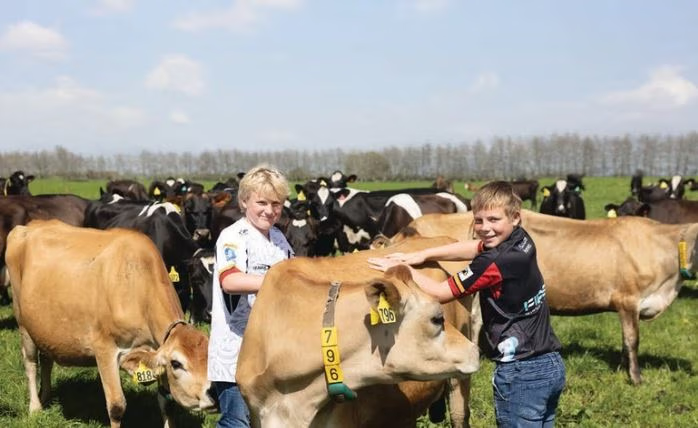
Claire and Brad are grounded when it comes to their future goals. There’s no pressure on their boys, Archie and Austin, to take over, but they’re proud that both have already shown an interest and like to lend a hand on the farm.
Brad often reflects on the moment his father handed over the reins to him, acknowledging how hard that must have been.
“When the kids bring me ideas of what they’d like to do with the farm, I’ll listen. Dad did that for me, and I’ll do that for my boys too.”
If the boys choose a different path, Brad and Claire will support them wholeheartedly. But for now, they’re quietly confident, the Payne Farm legacy will continue.